
One in Three
Perfectionism vs. Reality

Hello, and welcome to my newsletter! If you are new here, I create comics about adventures in a subterranean planet called Pelkern. I send these newsletters about my creative process every other month.
When my mom attended art school, one of her professors told her that “if one out of three [paintings] turns out, you are doing well.” My mom later passed that wisdom on to me. I have found it really helpful.
Sometimes the ratio is more like 2 out of 3 turns out. Sometimes it’s 1 in 4. But regardless of the exact ratio, I love the underlying principle. When you make pieces that don’t turn out, don’t sweat it. That’s just part of making. The next one, or the one after, will turn out. When you find the time and space to make, you’ll slowly progress.
For a lot of creative work, this means that a percentage of what you make won’t be made public. When working towards an art show, you make several pieces, and then select the pieces that fit the theme and meet the quality bar. When you are writing a rough draft, a chunk of what you write will be revised or eliminated in later drafts.
With comics, however, the process of drawing, inking, coloring, and lettering your comic pages takes a surprising amount of time. Revising or re-making a finished page is often too costly in terms of time and effort. It’s usually better to let the page be as is and move on to new pages, even when you’re not happy with how that comic page turned out.
I have a tendency towards perfectionism. I find it difficult to look at a comic page and say “good enough, send it.” All the winding paths of my brain sing “oh, but you need to fix this thing, and that thing, and this could be better.” It’s not that I feel ashamed that it’s not perfect, it’s more that I feel compelled to fix it, the same way that some people feel itchy when they see a tilted painting on a wall. But since comic pages take so long, I have to let go of my perfectionism with each page if I want to ever finish the story. So, I remind myself that only 1 in 3 pages will hit my expectations, and that’s okay. Just keep making.
I will mention, though, as a funny side-note, that there are draft-like stages at the start of the page-making process. Here is an example: skeleton frames. This is a method for figuring out character poses when you don’t have a photo reference. Here are a few that I’ve drawn recently:
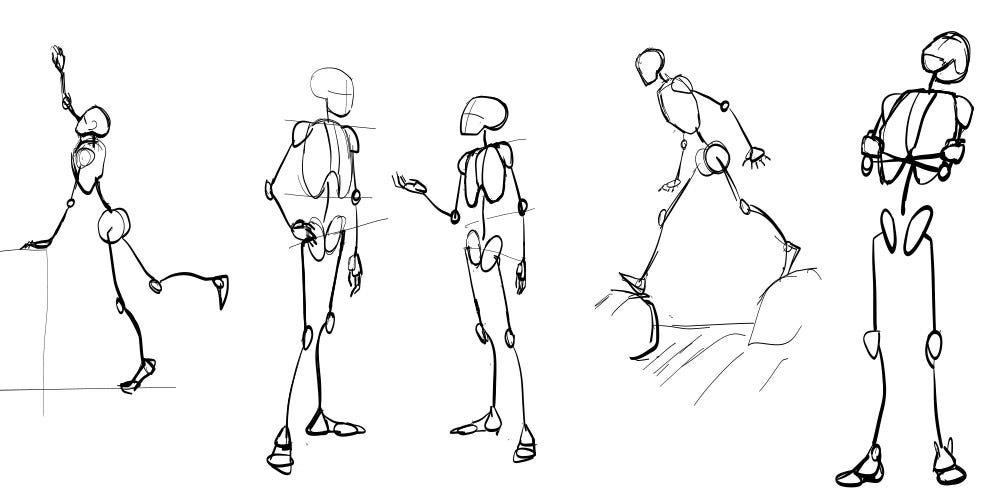
I can sketch these simplified skeletons quickly, so that means I can keep drawing versions until I find the gesture and angle that I need. The 1 in 3 principle applies to these too—or really more like 1 in 5, 1 in 10—but the ones that don’t turn out are easier to let go of because they’re fast to make.
Have you ever struggled with perfectionism when making? If so, what advice has helped you with it? Let me know in the comments.
Thanks for reading. See you in December!
—Bethany Sanders
I find that idea of the one in three really helpful when it comes to writing. I’ve had to learn in general to hold all my early drafting loosely and not get too tied to any of it because I just don’t know what’s going to come under the knife in the next round of editing.
& then at some point, I have to trust my instincts that a story is done—even though I know if I read it a year from now, that perfectionism is gonna ring out again with everything I’d want to change. But at the end of the day, I’d rather create several things that are good enough then spend my whole life trying to make one perfect thing.
Bethany, I'm also a perfectionist, so the 1 in 3 principle is so helpful! As is the skeleton frames idea. It makes me think about one type of rehearsal you can do in theatre: a "circus run," in which the whole cast acts in an intentionally melodramatic, intensely-emotional way as they run through the play as a way of experimenting with new ways of delivering lines and using gestures. I guess the writing equivalent would be drafting without scrutinizing every paragraph for perfection before you write another one?
Perfectionism in writing feels different than perfectionism in house-cleaning, or math tests, or other areas of life. I struggle with wanting a story that is "perfect" in the sense that it has just the right shape, the right atmosphere, and the right ending. Unfortunately, that's not just a matter of effort; it's a matter of inspiration, which you can't manufacture. Leaving it for a while and coming back to it is helpful, though. 😊